
ICSDG 2026: Key Insights on Collaborative Sustainability and Global Transformation
Practical Advice from Professor Carolin’s Publishing Workshop
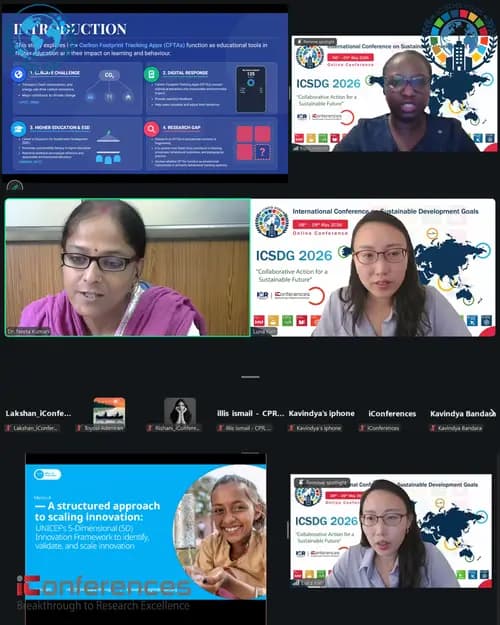
Dr. Illis Ismail Lecturer,Pusat Penyelidikan Dasar Centre for Policy Research (CPR) Universiti Sains Malaysia delivered an inspiring session on “Collaborative Action for a Sustainable Future,” emphasizing that sustainability is not limited to environmental protection alone in the joint conference of the 1st International Conference on Sustainable Development Goals (ICSDG 2026)
Dr. Illis Ismail Lecturer,Pusat Penyelidikan Dasar Centre for Policy Research (CPR) Universiti Sains Malaysia delivered an inspiring session on “Collaborative Action for a Sustainable Future,” emphasizing that sustainability is not limited to environmental protection alone in the joint conference of the 1st International Conference on Sustainable Development Goals (ICSDG 2026) and the 1st International Conference on Climate Change and Sustainability, organised by one of Asia’s leading conference organisers in Asia , iConferences.. According to him, true sustainability must also address social well-being and economic stability. A major highlight of his talk was the importance of collaboration among universities, governments, industries, NGOs, policymakers, and local communities. He explained that no single group can solve global challenges alone. Sharing examples from Sabah, Malaysia, he demonstrated how research partnerships improved the lives of small-scale fishing communities through better roads, schools, and healthcare facilities. He also introduced a seaweed cultivation initiative that empowered coastal women by enhancing their entrepreneurial skills and helping them access wider markets. In addition, he discussed how digital transformation in agriculture can improve productivity while supporting small farmers. Overall, the session encouraged systems thinking, inclusive innovation, and long-term collective action for sustainable development.
Prof.Ramesh Professor of Dr. M.G.R Educational and Research Institute, President of The Institution of Green Engineers, Member of UN High Level Political Forum delivered an energetic and motivational session on the urgent need to achieve the Sustainable Development Goals (SDGs) and the critical role young people must play in this mission. He pointed out that although the SDGs were introduced in 2015, global progress has remained slower than expected, making youth engagement more important than ever. A key focus of his talk was the role of digital technologies in advancing sustainability. He explained how artificial intelligence, IoT, data science, and cloud platforms can improve efficiency in areas such as energy use, agriculture, waste management, and transportation. He also stressed the importance of moving toward a circular economy where resources are reused and recycled instead of wasted. While acknowledging challenges like digital illiteracy, financial limitations, and ethical concerns related to AI, he encouraged students to go beyond awareness and actively participate in sustainability initiatives. His session delivered a strong call for youth leadership in building a greener future.
Dr.Patrick Paul Walsh Vice President of Education of UN Sustainable Development Solutions Network (SDSN), Vice President of Education and Director of the SDG Academy, School of Politics and International Relations, University Collage dublin, Ireland delivered a compelling talk on how global governance is evolving around the United Nations Sustainable Development Goals and what needs to happen before and after 2030. He introduced the “Pact for the Future,” a major 2024 agreement aimed at accelerating SDG implementation, reforming the UN system, and preparing for future global challenges. Although the SDGs provide a comprehensive roadmap with 17 goals and 169 targets, he highlighted a significant challenge: the gap between planning and practical implementation. Much of his discussion focused on the role of education in strengthening sustainability literacy across societies. Through initiatives such as the SDG Academy and Mission 4.7, education can empower individuals to better understand and contribute to sustainable development. He also warned about major global risks including climate change, inequality, and technological disruption. Overall, his session stressed that achieving the SDGs requires stronger international cooperation, governance reform, and the transformation of knowledge into coordinated global action.
Prof. Dr.Fatiha Hakimi Professor at the Hassan II Institute of Agronomy and Veterinary Medicine, Morocco delivered an insightful keynote on agroecology and its importance in creating sustainable agricultural systems within the framework of the SDGs. She explained that modern agriculture faces a serious challenge: producing enough food for a growing population while natural resources continue to decline. Instead of focusing solely on increasing production, she emphasized the importance of producing food in ways that are environmentally sustainable, socially fair, and economically resilient. Agroecology, she explained, combines science, farming practices, and community knowledge by working alongside natural ecosystems rather than against them. This approach promotes biodiversity, improves soil health, reduces chemical dependency, and strengthens local food systems. She also highlighted its strong connection to SDGs such as zero hunger, climate action, and life on land. Although scaling agroecology globally remains challenging, she stressed that it offers a long-term solution capable of strengthening environmental, economic, and social resilience while ensuring future food security.
Key Words
| Key word | Frequency |
|---|---|
| Sustainability | 6 |
| Sustainable Development | 5 |
| Climate Change | 4 |
| SDGs | 4 |
| Renewable Energy | 2 |
| Agroecology | 2 |
| Food Security | 2 |
| Circular Economy | 1 |
| Artificial Intelligence | 1 |
| Zero-Carbon Future | 1 |
| Climate Action | 1 |